By appointment only. Call or text (971) 374-4572 before you visit.

Add seaweed to any coral order for free standard shipping.

Check your water

Check your water

Bring a sample by appointment and we will help you read the numbers.

Enter a result to see where it sits.

  • 0 in range
  • 0 low
  • 0 high
SG

Target 1.024?1.026

Not tested

?F

Target 75?78?F

Not tested

pH

Target 8.1?8.4

Not tested

dKH

Target 8?9 dKH

Not tested

ppm

Target 380?450 ppm

Not tested

ppm

Target 1,300?1,450 ppm

Not tested

ppm

Target 10?30 ppm

Not tested

ppm

Target 0.01?0.1 ppm

Not tested

ppm

Target Undetectable

Not tested

ppm

Target Undetectable

Not tested

Want us to test it? Bring a water sample to your visit and we?ll message you the results.

Text us to book a visit

Start here

A path for your first reef.

New to saltwater? Take it in this order. Each step gives the next one a better chance.

  1. 1

    Let the tank cycle

    Before livestock, the tank needs bacteria that turn ammonia into nitrate. Wait until ammonia and nitrite both test at zero.

  2. 2

    Add a cleanup crew

    Snails and shrimp, like turban snails and skunk cleaners, graze algae and pick up leftovers.

  3. 3

    Start with forgiving corals

    Daisy Coral, Blastomussa and bubble corals tolerate small mistakes while you learn.

  4. 4

    Move up as it matures

    Fleshy LPS like Goniopora and Acanthophyllia do best in stable, mature systems. Save SPS until your numbers hold steady.

Care guides

From the shop notes.

What we tell customers at the counter, written down. Questions? Ask us.

Acclimating LPS corals

Husbandry

Acclimating LPS corals

A calm drip and stable parameters beat rushing a new piece into the display.

Drip acclimate for 45–60 minutes. Match temperature and salinity carefully. Start new LPS lower in the tank and raise light gradually over several days.
Reading your water

Water chemistry

Reading your water

Alkalinity, calcium, and magnesium work together — chase stability, not spikes.

Test regularly. Keep alkalinity steady first. Calcium and magnesium follow. Bring a sample by appointment if you want a second set of eyes.
Frag placement basics

Husbandry

Frag placement basics

Give sweepers space and put soft-flow pieces where pumps will not blast them.

Know which corals sweep. Leave room for inflation. Prefer indirect flow for goniopora, elegance, and bubble corals.

Reef glossary

Reef talk, translated.

The words you?ll see on our listings and hear at the counter.

Actinic
Blue reef lighting that makes corals fluoresce.
Acclimation
Slowly adjusting a new animal to your tank?s temperature and water chemistry.
Aquacultured
Grown in tanks or farms instead of collected from the wild.
Cleanup crew
Snails, shrimp, stars and other inverts that eat algae and leftovers.
Dip
A short bath for new corals that knocks off pests before they reach your tank.
Frag
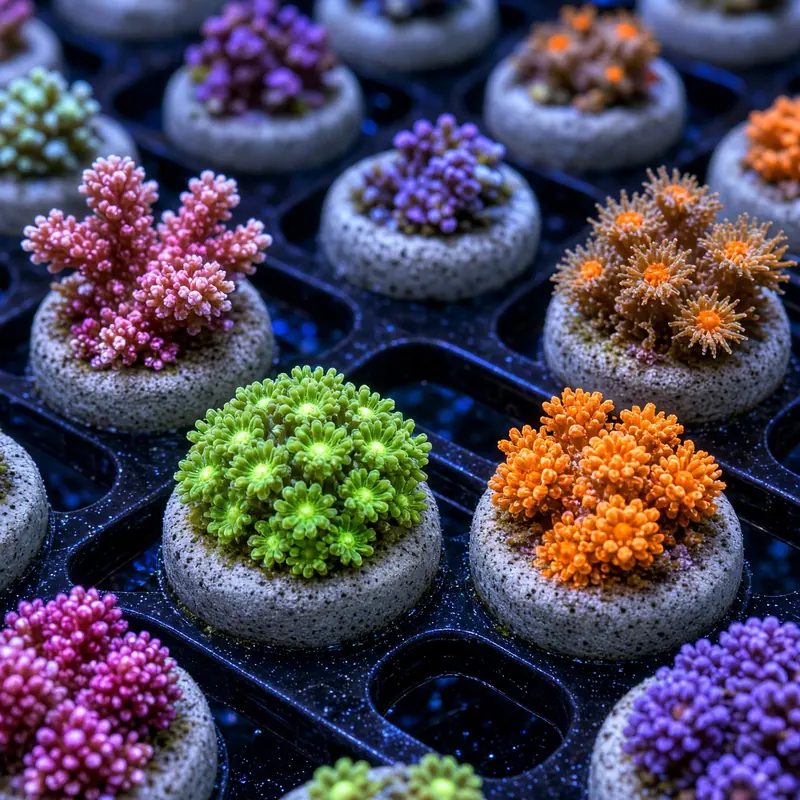
A small coral piece on a plug, grown into a new colony.
LPS
Large-polyp stony corals: fleshy corals like torches, hammers and brains.
PAR
A measure of the light corals can use. Higher PAR means stronger light.
Quarantine
A separate tank where new fish are watched before they join your display.
RO water
Water purified by reverse osmosis, used to mix saltwater and top off evaporation.
SPS
Small-polyp stony corals like Acropora and Montipora that want strong light, strong flow and stable water.
Sweeper tentacles
Long stinging tentacles some corals put out, often at night, to claim space.
WYSIWYG
What you see is what you get: the pictured coral is the one you receive.
Zooxanthellae
Algae living inside coral tissue that turn light into food for the coral.

Still have a question? Ask before you buy.

Send us a question (971) 374-4572